17 October 2024
by Andrei ALECSESCU
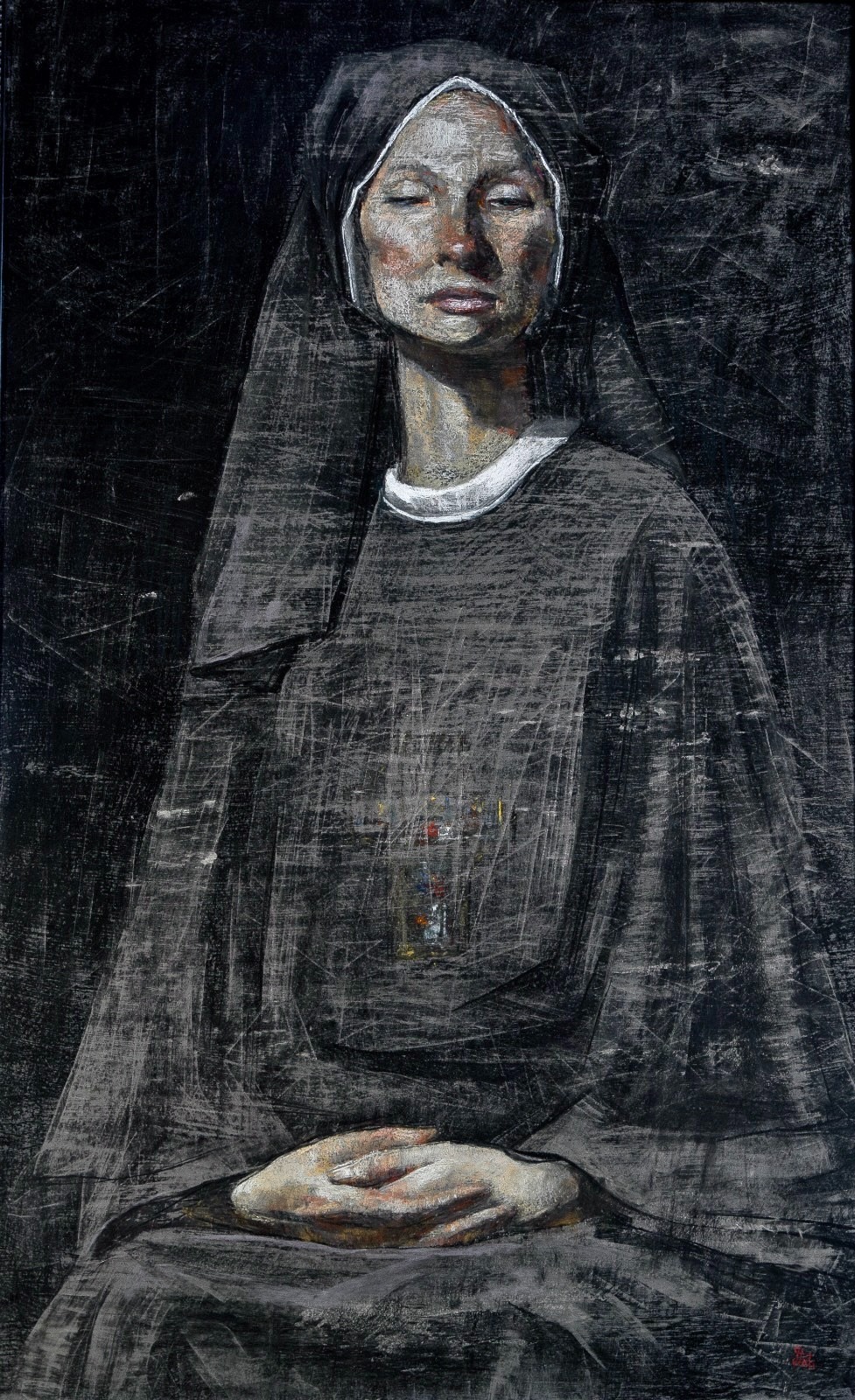
The work "The Speechless Nun" by Nicoleta Stati captures the viewer's attention through a profoundly meditative and introspective approach, characterised by formal subtlety and emotional complexity that evokes silence as a form of communication. This portrait transcends a mere representation of a religious figure; it serves as a profound commentary on the nature of spirituality and silence as a transcendent expression of the sacred.
At first glance, the visual impact of the work is shaped by the simplicity and minimalism of the composition. The painting explores the intensity of tranquility through the central figure of a nun, whose facial expression, with closed eyes and barely defined features, conveys a deep concentration on a reality beyond the material. One of the most remarkable technical features of the work is the colour palette dominated by dark tones, predominantly grey, black, and discreet accents of colour and white, which accentuate the solemn atmosphere of the image. The choice of these colours underscores the idea of retreat from the external world, inviting the viewer to contemplate the mystery of faith and devotion. Unlike a naturalistic approach that might strive to meticulously describe the texture and details of the face and garments, Nicoleta Stati opts for a more abstract style, where the figure of the nun dissolves into the somber background, as if on the verge of disappearing into her own silence.
The central figure of the nun, situated in an undefined space, emanates a state of absolute tranquility; however, this silence is not an absence but rather an intense presence filled with meaning. Her posture, seemingly immobile and rigid, embodies profound contemplation as well as spiritual surrender. The hands clasped before her represent a significant gesture, capturing the essence of religious devotion. They are rendered in precise detail, starkly contrasting with the rest of the body, where broad and diffuse strokes suggest a gradual dematerialisation of the physical form. These hands, shaped with a technical precision that reveals their fragility and vulnerability, become the pivot of the composition, as they express complete submission and a voluntary renunciation of any claim to autonomy.
This attitude of the hands is not merely a symbol of prayer but also a gesture of profound silence that transcends words, alluding to a state of inner communion with the divine. This form of silence is fundamentally different from imposed silence; it is chosen, embraced, and experienced as a form of spiritual liberation. Indeed, the title of the work, "The Speechless Nun," suggests this special condition of silence. The nun is not rendered silent; rather, she deliberately denies herself words, aware that, in the presence of the sacred, any verbal expression is inadequate.
This idea is amplified by the manner in which the artist has rendered the nun’s face. Her features are subtly sketched, and her facial expression, while seemingly neutral, is saturated with meaning. The closed eyes not only indicate a withdrawal from the external world but also suggest an act of profound introspection, a refusal of any interaction with immediate reality. This self-enclosure may be interpreted as a quest for inner knowledge, one that transcends the physical senses and moves towards a more subtle, mystical understanding of the divine. The face, almost immaterial, reflects this state of surrender and anonymity—through the act of closing her eyes, the nun not only negates her own physical presence but also turns towards an unattainable dimension, where the soul merges with the sacred.
Moreover, the aesthetics of this work appear to underscore a permanent tension between the concrete and the abstract. While the hands are clearly defined and rich in detail, the rest of the nun's body fades into her garments, which, in turn, seem to fuse with the dark background, suggesting an evaporation of materiality. The monastic robes, dominated by shades of black and grey, serve not only as religious attire but also as a symbol of renunciation of any personal identity. Black, a classic symbol of death and mystery, here becomes not only a metaphor for "death" to the world but also a symbol of the spiritual quest for divine light within darkness. The texture of the garments is intriguingly treated by the artist—they are not rendered in a realistic manner but rather in an almost abstract style, textured and outlined with hard lines, suggesting a process of erosion. This may imply that the garments, although external, are not important in themselves but merely serve as a vehicle for the nun’s interiority. They appear to dissolve into the dark background, thus reflecting the idea of losing individual self and integrating into something vaster that transcends material existence.
The background of the work also plays a crucial role in constructing the painting's meaning. It seems to "consume" the figure of the nun, placing her in an undefined space devoid of coordinates, where any reference to the material world disappears. It is not a defined space; there are no elements that clearly contextualise the scene, which accentuates a sense of timelessness and immateriality. The background is not a mere backdrop; it functions as a psychological space, a place of meditation, a "territory" of the sacred. Its texture, rough and scratched, creates an atmosphere of uncertainty and mystery, a void in which the figure of the nun floats. In this manner, Nicoleta Stati creates a subtle balance between the concrete figure of the nun and the abstract space surrounding her, a space that becomes, in turn, a metaphor for silence and the infinite.
Through this chromatic and compositional reduction, Nicoleta Stati affirms her intention to concentrate attention on the spiritual essence of the character, eliminating any external element that might distract the viewer. The work thus becomes an act of visual meditation, an invitation to silence and reflection. While silence is implicit in many works of religious art, in this case, it becomes explicit, materialised in the posture of the nun, in her closed eyes, and in the immobility of her gestures. The nun communicates nothing verbally, yet her powerful presence, laden with intense silence, conveys more than words ever could.
The apparent simplicity of the composition conceals a profound complexity. The painting is not merely a religious portrait but a philosophical exploration of the human condition in relation to the divine. In this work, Nicoleta Stati meditates on the relationship between silence and knowledge, between the visible and the invisible, between materiality and spirit. The vast, unfathomable black background becomes a metaphor for a spiritual abyss into which the nun immerses herself—not to be lost but to be rediscovered in a new dimension, one in which silence is no longer an absence but a form of absolute presence.
Thus, "The Speechless Nun" emerges as an eloquent example of art that transcends mere visual representation, accessing a profoundly symbolic dimension. The work not only invites the viewer to contemplate the image but also to engage in personal introspection. It is a visual meditation on silence as an act of supreme devotion and on the capacity of art to express that which words cannot. In the face of this work, the viewer is confronted not only with the image of a nun in prayer but also with their own relationship with silence, introspection, and the mystery of existence. Through this painting, Nicoleta Stati creates a space in which spirituality becomes tangible, and silence becomes the final word of knowledge.
