5 November 2024
by Andrei ALECSESCU
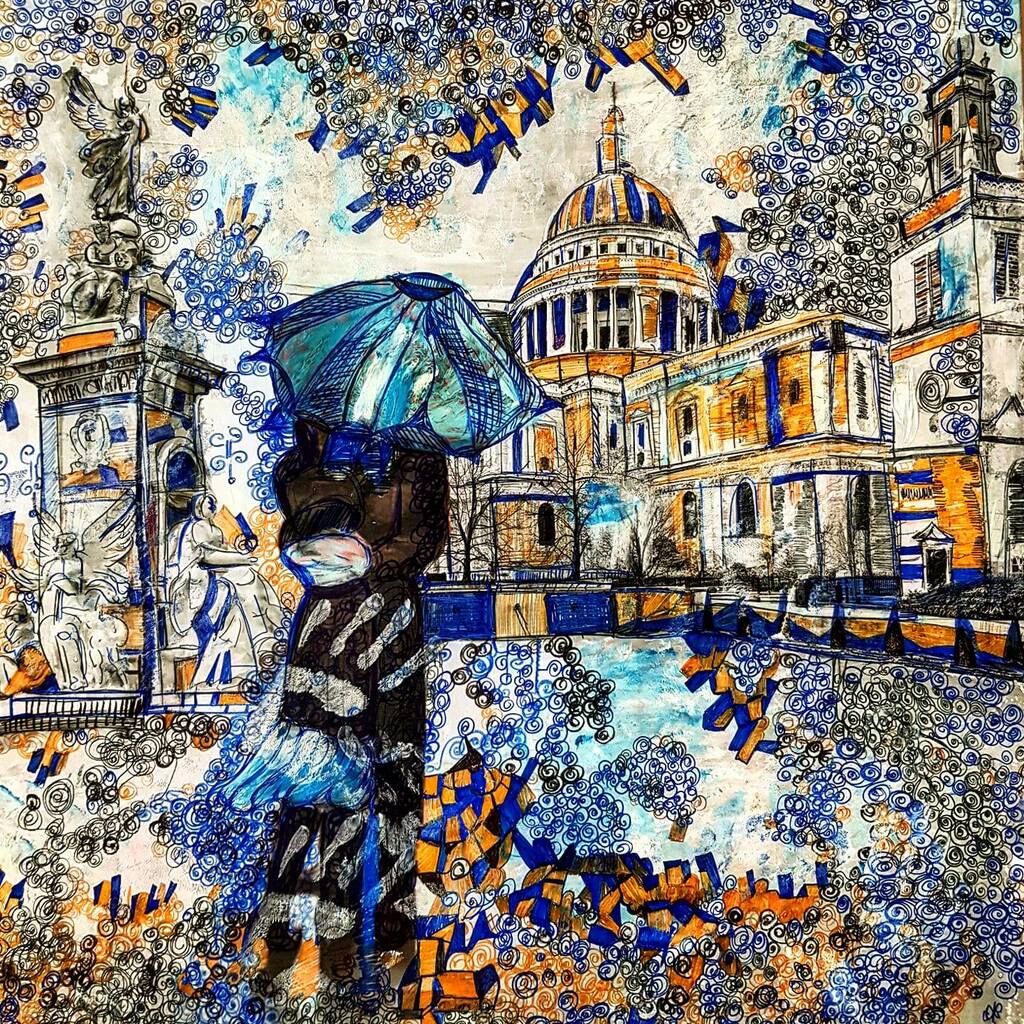
In her work “LOOKING FOR A SHELTER”, Ana NECOLAU unfolds a nuanced vision of contemporary urban space, where the city assumes a dual role as both sanctuary and labyrinth, as both shelter and impersonal vastness. This painting, created in 2020 using a mixed-media technique on canvas, combines a figurative approach to London’s architecture alongside an expressive, abstract language that heightens the work’s psychological and emotional depth. Through meticulously placed details and carefully orchestrated chromatic symbolism, NECOLAU invites the viewer to navigate a richly layered texture of meanings and emotions.
/ THE CONTEXT OF SPACE AND ARCHITECTURAL IDENTITY /
The artwork unfolds against the backdrop of an iconic landmark: St Paul’s Cathedral, an emblematic structure of English Baroque architecture and a symbol of historical resilience. By selecting this building, the artist creates a dialogue between the human figure and architectural space, transforming the city-container into a tacit yet omnipresent character. The cathedral, with its grand proportions and symmetrical lines, evokes a sense of timeless strength and stability. In contrast, the female figure holding an umbrella, positioned prominently in the foreground and marked by a fragile, ephemeral presence, symbolizes the vulnerable individual seeking refuge in the city's vastness. NECOLAU skillfully leverages the symbolic power of architecture as a sign of permanence and spiritual protection, but a subtly undermining it through her composition to craft a scene where this monumentality paradoxically becomes a source of alienation. In this sense, the cathedral is not merely a neutral backdrop but an active participant in the composition, an edifice reflecting both the aspirations and the fragility of a personal urban experience.
/ THE DIALOGUE BETWEEN FIGURATIVE AND ABSTRACT /
NECOLAU constructs the work in a manner that oscillates between the figurative and the abstract, a stylistic choice that allows for the simultaneous existence of architectural concreteness and psychological impressions. The architectural details of the cathedral are clearly defined, with precise lines and a realistic rendering of proportions, a technique that imparts to the work a tangible, almost photographic dimension. At the same time, the background is animated by an amalgam of spiralling forms and turbulent decorative elements that draw from the language of Art Nouveau, yet transcend mere ornamentation to signify a mental state of agitation, a perpetual flow of thoughts. These lines and spirals, rendered with a certain freedom and fluidity, impart a dreamlike quality to the composition, as if the city itself were imbued with a vibrant energy, a latent and dynamic presence. In this context, the abstract elements become a form of emotional topography, transposing not only the structure of urban space onto the canvas but also a chromatic code of inner experiences. They function as a map of the psychic space, where architectural details are juxtaposed with fragments of emotion and intuition.
/ THE SYMBOLIC DIMENSION AND FUNCTION OF THE UMBRELLA /
In the foreground, the umbrella becomes a polyvalent symbol, laden with contradictory meanings. While, conventionally, the umbrella serves as protection against the elements, here it also appears as a metaphorical barrier, a symbol of the need for protection against the city’s impassive vastness. The deep blue of the umbrella suggests introspection and melancholy, intensifying the figure’s sense of isolation and fragility. In this context, the umbrella may be interpreted as a psychological shield, an attempt to create distance between the self and an overwhelming urban reality.
At the same time, the umbrella acts as a compositional frame, directing the viewer’s gaze towards the female figure and the cathedral, establishing a point of tension between the personal element and the monumental urban landscape. This tension is essential to the work’s understanding, suggesting a complex interaction between the individual and their environment. NECOLAU uses the umbrella not merely as a functional object but as a potent symbol of isolation and the search for safety in an ambivalent setting. This transformation underscores the artist’s intention to explore themes of human vulnerability and fragility, as well as the need to find refuge amidst urban turmoil. Thus, the umbrella becomes a central element in the visual narrative, inviting the viewer to reflect on their own experiences of alienation and the search for a sense of belonging in an increasingly complex world.
/ CHROMATIC SEMIOTICS AND EMOTIONAL CONTRASTS /
The colour palette, dominated by blue and orange, operates as a chromatic juxtaposition of intensity, reflecting a state of emotional tension. Blue, used in the character’s umbrella and architectural details, induces a sense of introspection and melancholy, evoking distance and tranquility, while orange adds a note of restless energy, symbolising the city’s vitality and its unceasing dynamism. This chromatic opposition suggests a duality of experience, an ambivalent encounter between contemplation and urban bustle.
The contrast between the blue of the shadows and the orange of the architectural details creates a chromatic dissonance that speaks to the urban paradox: the city is simultaneously a refuge and a source of anxiety, an imposing yet distant presence. In this way, NECOLAU effectively shapes her theme through the use of colour, translating a complex emotional state into a refined aesthetic composition.
/ INTERPRETING ALIENATION AND THE CONCEPT OF URBAN REFUGE /
Thematically, “LOOKING FOR A SHELTER” can be interpreted as a meditation on alienation within urban space, exploring the symbiotic and tension-filled relationship between the individual and the city. The female figure emerges as an alter ego for the viewer, symbolising the modern person in a perpetual search for safety and identity within a vast and impersonal public space. The work thus reflects a subtle commentary on the human condition in an era of rapid urbanisation, where intimacy and closeness are threatened by structures that seem to dominate and overshadow the individual.
The sought refuge is not merely physical but also psychological. Although the city appears to be a place of apparent shelter, it becomes a source of anxiety, and the quest for refuge takes on the dimension of a search for self in an environment rife with contrasts. Through this exploration, NECOLAU introduces an existential nuance to the work, suggesting that true refuge may be illusory, as volatile and fragile as the umbrella carried by the central character.
/ INSTEAD OF CONCLUSIONS /
Through “LOOKING FOR A SHELTER,” Ana NECOLAU constructs a complex visual metaphor that transcends the mere representation of an urban scene, evolving into a reflection on the human condition in a world dominated by monumental structures and social pressures. The mixed-media technique and meticulously orchestrated composition convey a dense atmosphere of symbols and meanings, providing the viewer with a layered visual experience where each detail contributes to the exploration of a universal theme.
Thus, “LOOKING FOR A SHELTER” is not just a work of art; it is a plastic and philosophical discourse on modern alienation, an invitation to introspection and a profound analysis of our relationship with space and identity. Here, Ana NECOLAU demonstrates her ability to shape not only images but also ideas, transforming the canvas into a space for inner dialogue where human fragility and architectural monumentality coexist in a perpetual tension.
