4 April 2025
by Andrei ALECSESCU
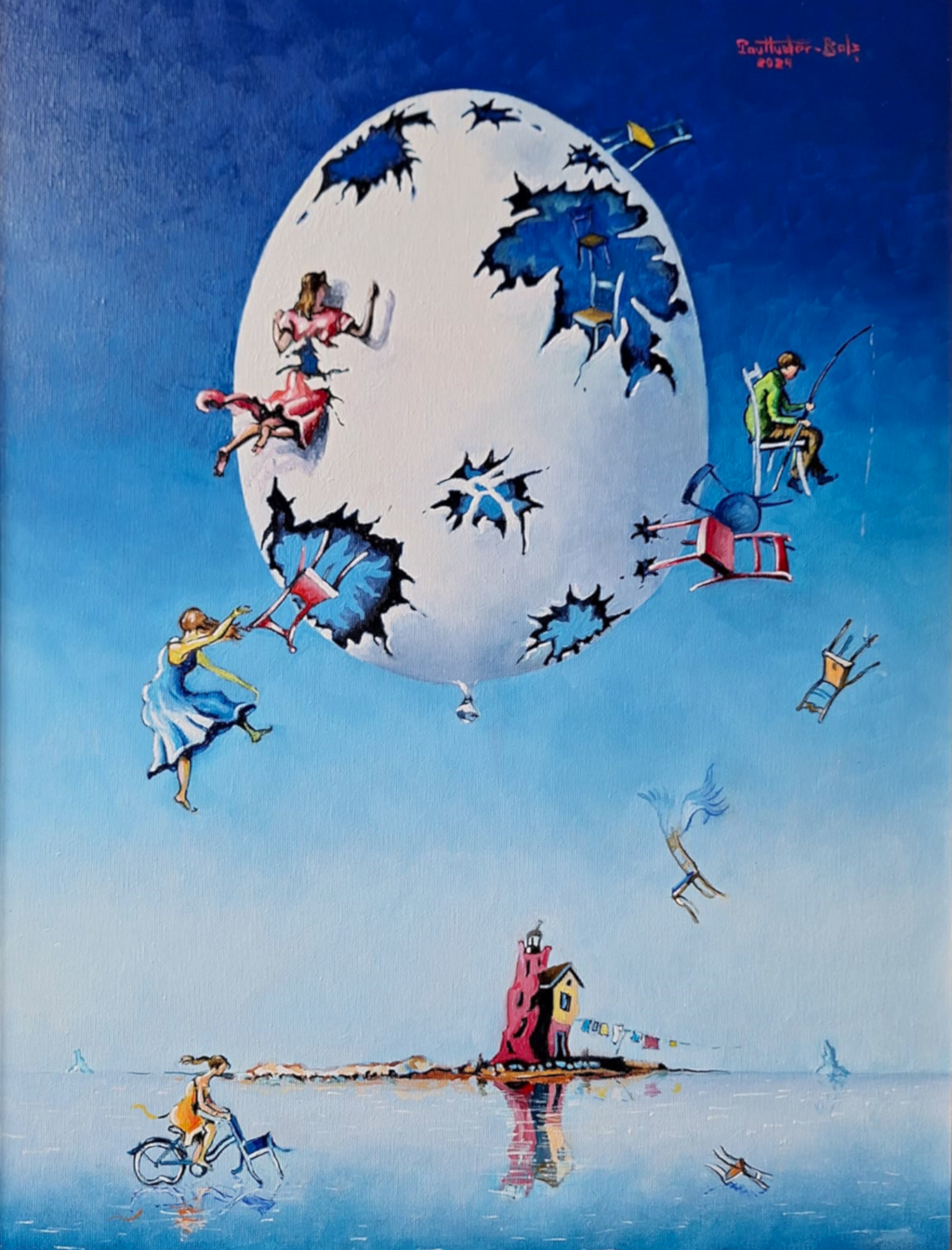
Any authentic work of art is, essentially, an invitation to transcendence, a window to a dimension inaccessible to common perception, a call to surpass the limits of immediate reality. The work "The Dream of a Chair" by Professor Paul TUDOR - Balș is not just an aesthetic exercise, but an inaccessible space to ordinary perception, where the boundaries of reality dissolve, and traditional meanings are suspended. In the eyes of the viewer, "The Dream of a Chair" becomes a point of convergence between art and philosophy, between image and thought. This painting does not provide answers, but incites reflection. The chair, although seemingly familiar, is not limited to its objective functionality but becomes a pretext for a meditation on the fragility of existence and the precarious balance between order and chaos. Through an aesthetic that combines the dreamlike suggestion with compositional rigor, the artist creates a bridge between the visible and the invisible, between the concrete and the abstract. In front of this work, the viewer is invited not only to contemplate but also to actively participate in a search for meaning, to stop for a moment and reflect on the essential questions about the nature of reality and our place within it.
/ AN INTERSECTION BETWEEN SURREALISM AND MAGIC REALISM – A SEARCH FOR MEANING /
The work stands at the intersection of dreamlike surrealism and subtle magic realism, blending established artistic traditions, such as those of Salvador Dalí and René Magritte, with a strong personal identity. Paul TUDOR - Balș brings to the forefront a visual poetics that confronts us with the fundamental contradictions of existence, challenging us to reconsider what "reality," "time," or "subjectivity" mean in a constantly changing universe. Far from being merely a work to contemplate, "The Dream of a Chair" is a philosophical discourse in the form of a painting, a call for introspection about the fragility of the human condition and the tension between stability and chaos, two elements that define each moment of our lives.
/ THE SYMBOLISM OF THE EGG – BIRTH AND SELF-DESTRUCTION IN THE SAME GESTURE /
The central element of the work is the egg – the primary symbol of genesis, birth, and potential, but also of disintegration. The egg is not whole but cracked, a sign of a birth that is, at the same time, a self-destruction. From these cracks, which spread in an inevitable process of disintegration, objects, characters, and especially chairs emerge – symbols of a world in a continuous process of metamorphosis. The egg thus becomes a paradox of existence, between the potentiality of a beginning and the inevitability of an end. It reminds us that all things are in perpetual change, with fragility and transformation being the fundamental constants of being.
/ THE CHAIR – A REFLECTION ON THE PRECARIOUSNESS OF EXISTENCE /
The chair, a common object, a symbol of comfort and stability, becomes in this painting emblematic of the precariousness of the human condition. It is no longer a simple support, but a "shattered" and volatile entity, floating in a universe where known order is suspended. Freed from its utilitarian function, the chair becomes a reflection of human free will, but also of the void of absolute freedom. Like the individual aware of their own fragility and limitations, the chair floats in an existence between order and chaos, between stability and uncertainty. Is its freedom a curse or a blessing? Perhaps only by freeing ourselves from traditional supports can we truly understand our ontological fragility, and perhaps, in this process, we even discover the true essence of existence.
/ THE COLOR PALETTE – A UNIVERSE OF IMPONDERABILITY AND ALIENATION /
The color palette plays a crucial role in amplifying the state of imponderability characteristic of dreams. The predominant shades of blue create a framework that seems to blur the boundaries between reality and dream, between the concrete and the illusory. These colors are not merely an aesthetic choice but a means through which the artist conveys a state of floating, of the fragility of the human being in the face of a world in constant transformation. The pastel tones of the characters contrast with the dense background, deepening the feeling of alienation and a break from immediate reality. Between dream and reality, people are captives in a universe where certainties no longer exist.
The red house on the island, seemingly solid in an ephemeral world, is another symbol of a point of stability that can no longer be reached. Is it a final memory of a safe place, or merely an impossible promise? In the midst of transience and chaos, it becomes a symbol of a lost world, a memory of stability that can never again be real.
/ THE SUSPENSION OF EXISTENCE – THE INDIVIDUAL BETWEEN REALITY AND ABYSS /
The characters in this suspended universe are unable to anchor themselves in certainty, floating between worlds, between reality and abyss. Every gesture, every movement becomes a symbol of the fragility of human existence, an absurd struggle to maintain balance in a fluid and uncontrollable reality. The figure pedaling on the surface of the water is perhaps the strongest symbol of this illusion of stability, an act of will in a world where control is impossible. Existence thus becomes a permanent illusion of stability, a continuous struggle between uncertainty and certainty, between the desired order and the inevitable chaos.
/ CONCLUSION – A WORK OF ART THAT LIVES IN THE REFLECTION OF THE VIEWER /
"The Dream of a Chair" is not merely a work of art, but an invitation to introspection and a philosophical manifesto. It not only opens a window to a parallel world but challenges us to rethink our role in this world and the meaning of existence. Paul TUDOR - Balș constructs a universe in which ordinary objects are stripped of their utilitarian functions and original meanings, and human beings are suspended between certainties and uncertainties, between physical and ideological worlds. The work thus becomes a palimpsest of the great philosophical questions that have accompanied human thought since its beginnings: What is reality? What does it mean to have a foothold in the midst of chaos? Can something exist without having a determined function?
Through its symbolic complexity, the subtlety of its technique, and its visual force, "The Dream of a Chair" provokes the viewer to enter a territory of uncertainty, where universal truths are not clear, and answers never come easily. In the end, the work transforms from an aesthetic challenge into a profound visual experience, in which certainties dissolve, and the only constant remains change. Thus, "The Dream of a Chair" is a work of art not only to be contemplated but to be lived, an ongoing exercise in reflection on the fragility and paradoxes of human existence.
